What Will Gameplay Be Like in Snezhnaya?
HoYoverse sells Snezhnaya as the Cryo nation where the Fatui consolidate power—winters engineered as much as endured. Recent “Frozen Tundra” style clips make that tangible: railways as levels, industrial silhouettes, and combat reads in military fantasy lighting rather than Mondstadt’s pastoral calm or Fontaine’s courtly spectacle.
This article is written from the preview’s own visuals. Broader HoYoverse Snezhnaya programming and press coverage in 2026 have floated an August launch window, but treat dates and feature lists from streams as marketing while the teaser remains visual intent that can still change. Every combat or system detail here is work in progress; the footage carries an on-screen development disclaimer.
The headline difference: Snezhnaya is “industrial Cryo,” not just “cold Liyue”
Most past regions telegraph their gameplay hooks through geography and culture. Mondstadt is windmills, cliffs, and gentle vertical puzzles. Liyue stacks karst pillars and human commerce on stone. Inazuma isolates islands under storm law. Sumeru braids rainforest grapple routes with desert monuments. Fontaine asks you to rethink verticality through water. Natlan leans into stamina-adjacent traversal fantasies tied to its tribes.
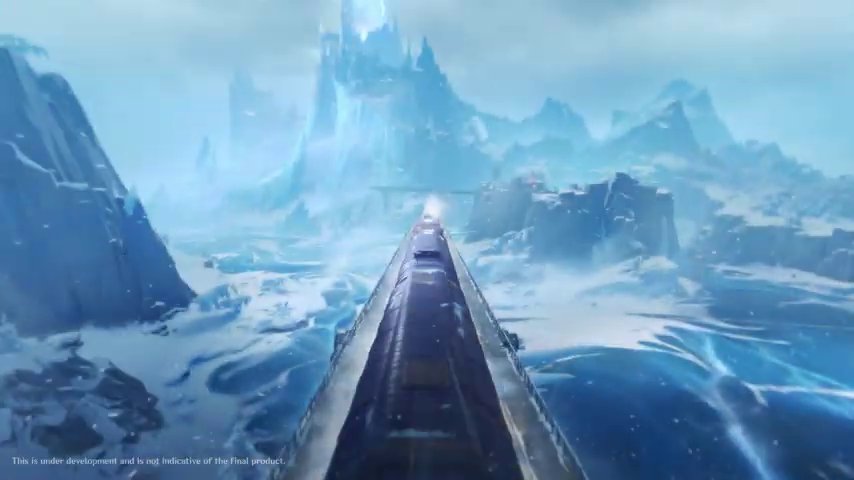
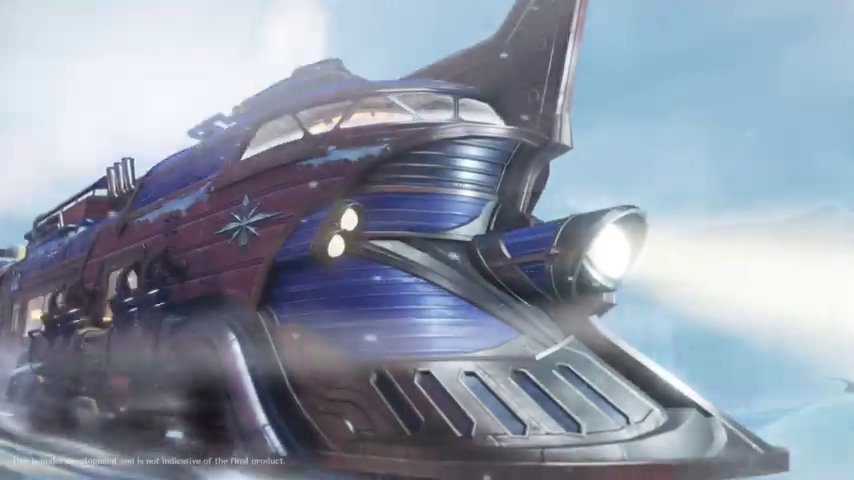
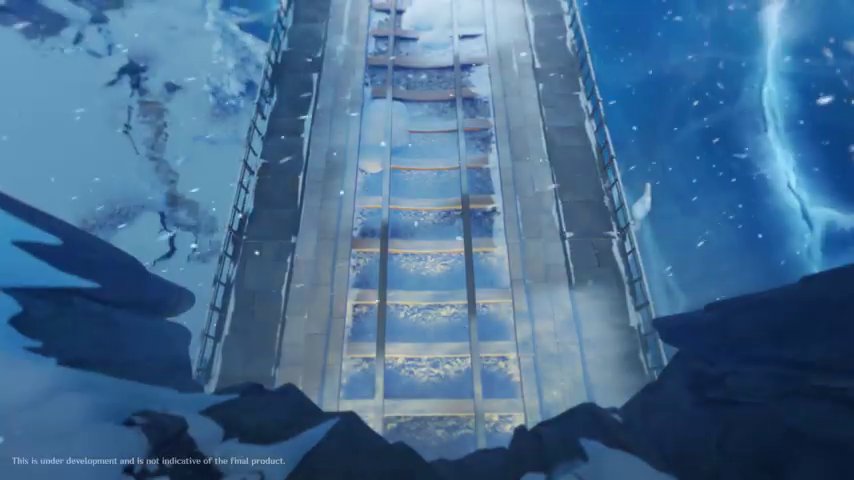
Snezhnaya’s preview instead keeps returning to heavy machines in a white void: a maroon-and-blue locomotive punching through blizzard light, top-down shots of ties and guardrails stretched over blue cracked ice, and camera placements on the roof of a moving train as a glowing citadel dominates the skyline. That is a different fantasy than Dragonspine’s survival climb or Fontaine’s art-nouveau baths. It is closer to “Arctic logistics nation” than to “pretty ski resort.”
If the final map matches this language, exploration may feel less like wandering a painterly biome and more like riding infrastructure: bridges as deliberate sightlines, steam as a motion cue, fortifications hugging the same corridors your transport uses. That would be a tonal shift even when the underlying loop—Statues, chests, puzzles, camps—remains familiar.
Interiors as first-class gameplay spaces
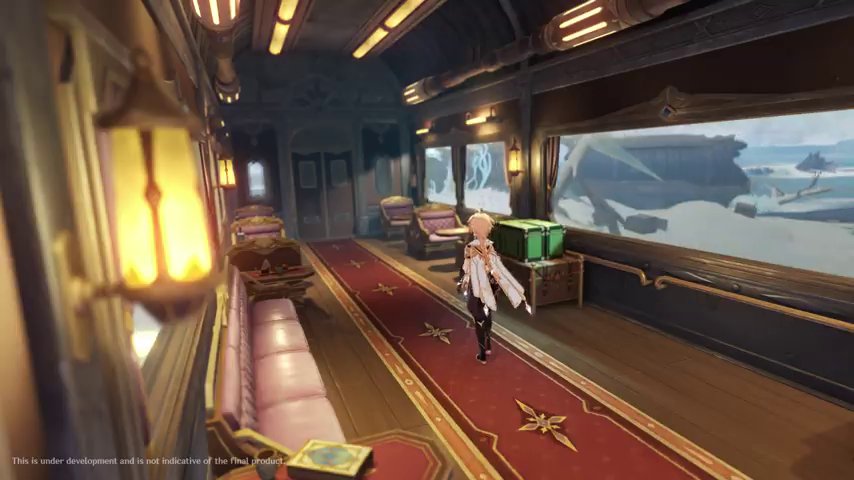
One sustained beat follows the male Traveler down a luxury carriage: long red runner with gold star motifs, tufted seating, stacked trunks, and wide windows reading onto wreck-like silhouettes on the ice. The camera treats the car like a corridor shooter level—leading lines, deliberate pacing, contrast between warm interior light and lethal exterior color temperature.
Other regions have interiors, yet they are rarely the hero setting of an overworld teaser. Snezhnaya’s preview leans into corridors, vaulted ceilings, and framed vistas in a way that suggests scripted traversal, set-piece fights, or hub carriages rather than a single static inn room. Official Snezhnaya programming has emphasized trains as lived-in spaces; if that lands in-game, stations and cabins could behave more like small open districts than like teleport menus.
Overworld spectacle: ice fields, bridges, and a citadel anchor
The shot chosen for this article’s hero frame is deliberately wide: from atop the train, the route pushes toward translucent blue ice, mid-distance fortified cliffs, a long bridge, and a colossal peak crowned with cool blue light. The composition reads like an answer to a design question—“how do we sell Snezhnaya in one camera move?”—and the answer is scale plus infrastructure.
Compared with Inazuma’s fractured vertical islands or Sumeru’s layered canopy, this is horizontal grandeur: fewer ropes, more sightline management across tundra. Navigation may reward reading rail lines and distant beacons instead of ping-ponging between Electrogranum or Four-Leaf Sigils—kinesthetically different, not necessarily harder.
Combat: Cryo-forward, town-bound, and deliberately chaotic
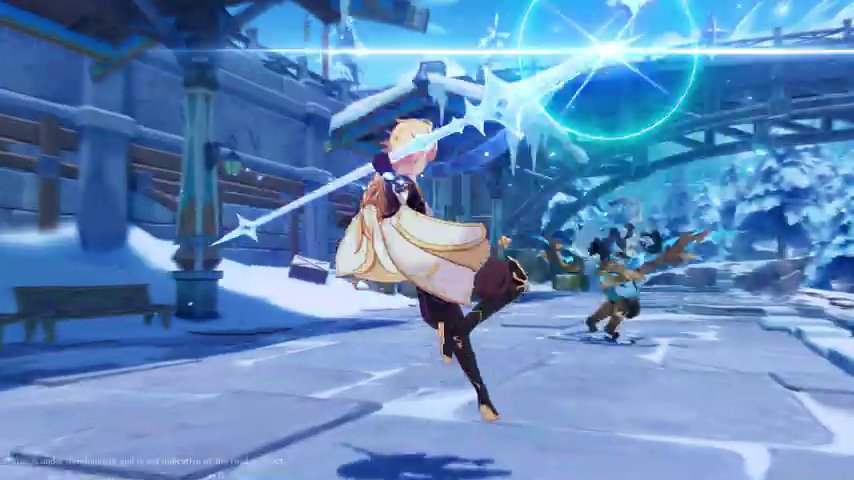
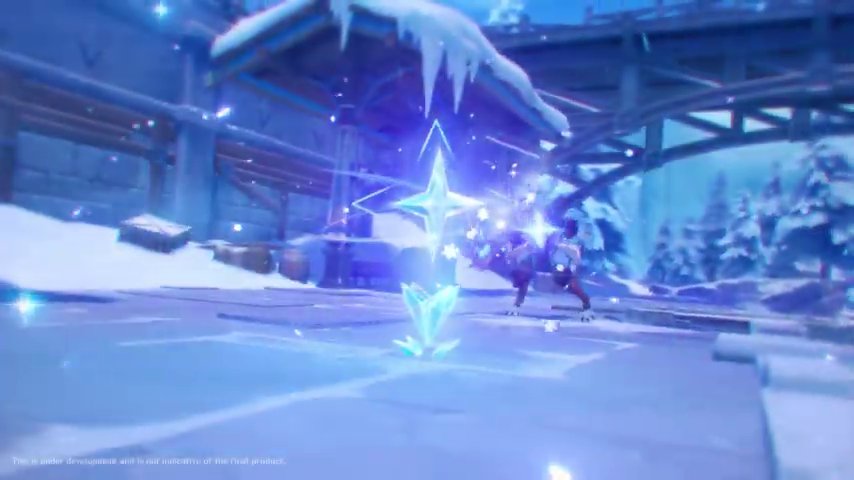
Later beats shift to Aether skirmishing in snowy plazas with timber architecture and arched bridges. One strike reads as a long crystalline weapon with a horizontal flare and teal shockwave; another moment centers a hovering four-pointed ice star with particles while a quadrupedal beast lurks behind the effect. Indoor sequences push radial Cryo bursts and scanlined, industrial rooms—high contrast, cool palette, Fatui-coded silhouettes.
Against Mondstadt’s lighter camp clears or early Liyue’s Geo slab puzzles, Snezhnaya’s combat skews denser VFX and tighter arenas: more particles, more bloom, more elite or scripted reads. Players who want minimal UI noise may lean harder on audio and silhouettes; players who love spectacle get Cryo that owns the whole screen, not only a melt number.
A UI hint that Snezhnaya may track cold as a mechanic, not only as set dressing
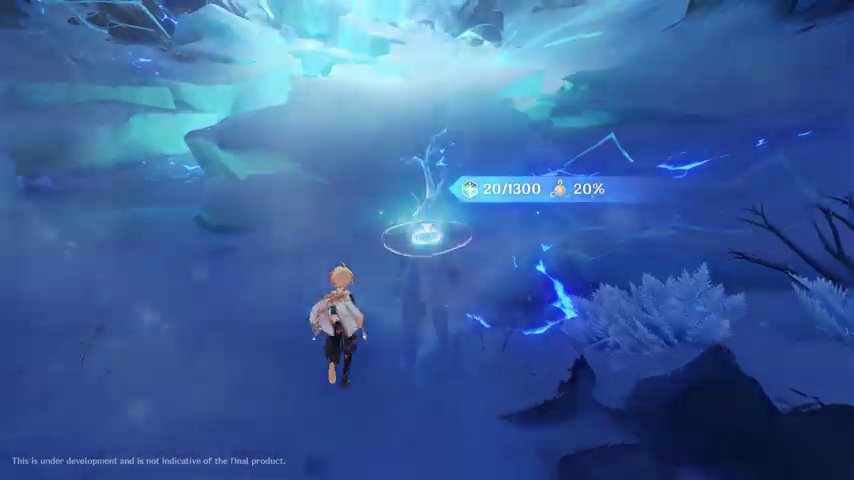
One exploration shot is telling: Aether crosses reflective ice toward a cavern glow while a translucent HUD strip pairs a snowflake counter (visually ~twenty of a much larger cap) with a flask meter near twenty percent, plus a floor ring and floating blue gadget. Even if numbers change, the UI shape argues for an environmental meter—Dragonspine’s Sheer Cold lessons at region scale, or a gadget charge tied to frost traversal.
Progression landmarks still echo Genshin’s language—then twist it
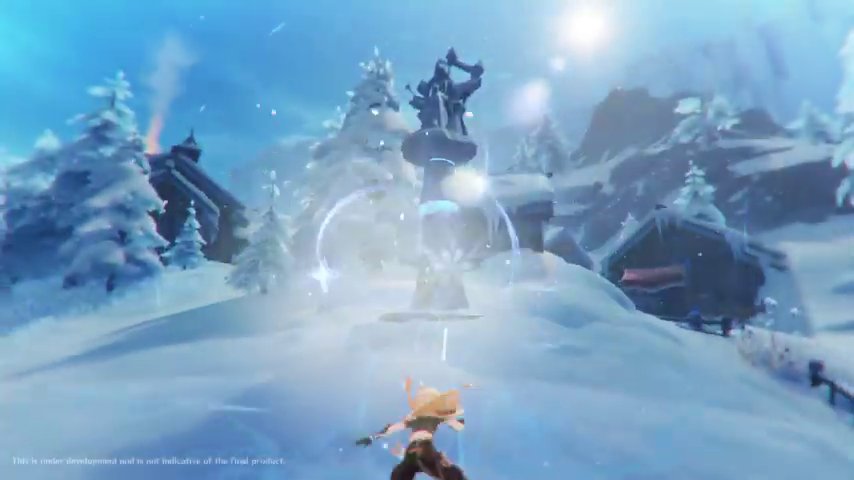
The preview still includes a Statue of the Seven moment: Aether jogs toward a tall monument crowned with a Cryo-toned figure, cyan ring on the plinth, soft aura on the ground, huts and pines under a bright, flared sky. That is the familiar “you are in a new nation” dopamine hit. Readers tracking official announcements and patch windows alongside teaser footage often consult Genshin Impact news roundups for dates HoYoverse has not pinned in a trailer yet.
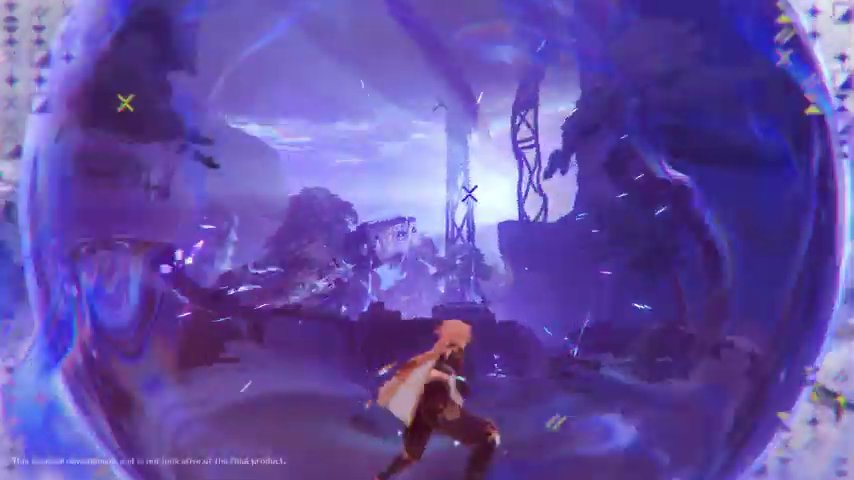
What surrounds that familiarity is not. Snezhnaya frames purple glitch overlays, massive translucent domes with chromatic fringing, lattice pylons, and night airships glowing blue-violet. One shot locks Aether inside a huge purple sphere while industrial towers silhouette outside—more “Fatui laboratory field” than “Anemo God plaza.”
Story presentation: Fatui theater, masks, and the Traveler’s new coat
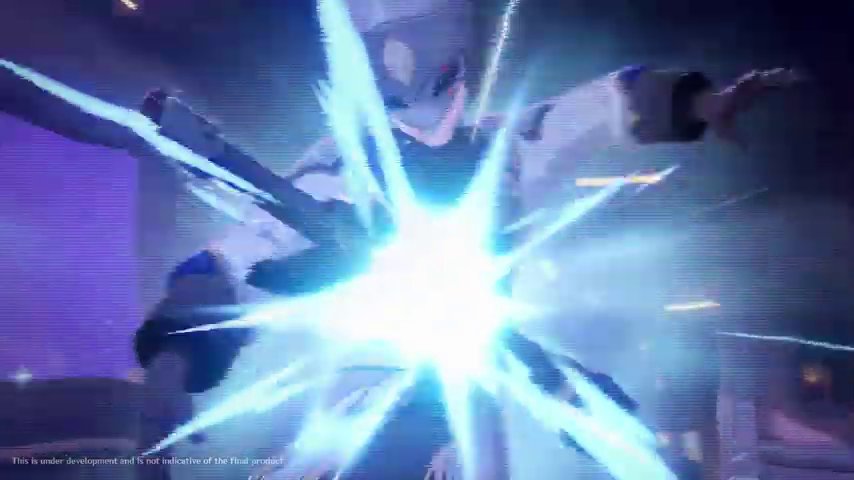
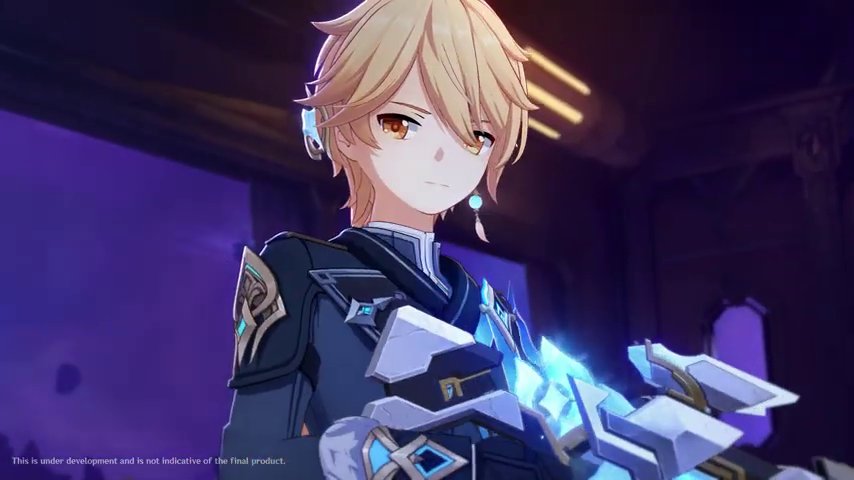
A late beat leans hard into masked winter uniforms and a cyan starburst that fills the frame—classic Snezhnaya villain theater. Immediately after, the preview spotlights Aether in a new dark military coat with teal inlays, fur cuffs, and a crystalline mechanical object that blooms cold light across his face. That sequence reads less like “optional skin advert” and more like “this gadget is the chapter MacGuffin,” similar to how certain Fontaine quests center key props—only here the palette is violet-black industrial night instead of opera-house gold.
For players comparing regions, the emotional shift is stark: Mondstadt trusts knights and bards; Liyue tests contracts; Inazuma tests law under eternity; Fontaine tests spectacle-as-truth. Snezhnaya’s preview asks you to trust machines, masks, and monitored interiors—a recipe for more instanced set pieces and surveillance-map aesthetics than a sunny plateau ever needed.
Bottom line
If the shipped region follows this vocabulary, Snezhnaya will feel different because it fuses Cryo fantasy with mass transit and industrial scale, stages fights in tight, high-contrast arenas, and hints at cold-related UI instead of reskinning older regions with snow. The open question for launch day is whether ice, rail, and meters become verbs the way Fontaine made water a verb—the preview argues they might.